
MICROSOFT POWER PLATFORM GOVERNANCE REVIEW
Get control of Power Platform before Copilot and AI adoption expands
Power Platform can spread quietly through Microsoft 365. Useful apps and flows may become business-critical before IT has a reliable inventory, clear owners, effective data policies or a support model. Stygian’s Power Platform Governance Review shows what exists, where the material risks sit and what should happen next.
The review covers Power Apps, Power Automate, Dataverse, environments, makers, connectors, sharing, ownership, support and lifecycle controls. It also considers whether current governance is strong enough for wider Copilot Studio, AI agent and low-code adoption.
The objective is not to stop business-led innovation. It is to create proportionate guardrails so useful automation can scale without creating avoidable security, compliance, support or continuity risk.
Your trusted UK Microsoft consultancy.
What is a Power Platform Governance Review?
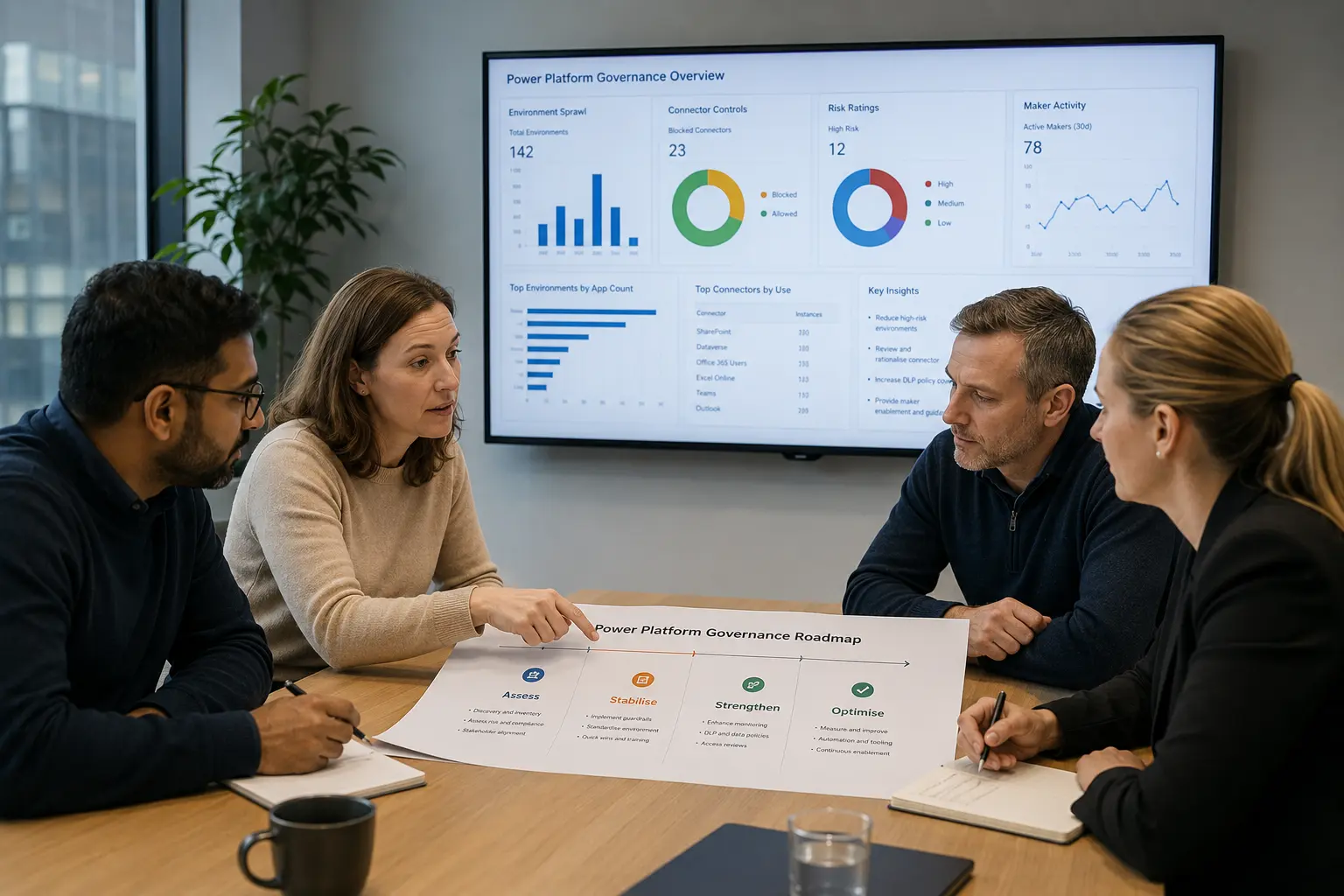
A Power Platform Governance Review is a structured assessment of how Microsoft Power Platform is being used and controlled across an organisation. It reviews visibility, environments, ownership, data policies, connectors, sharing, support and lifecycle practices, then converts the evidence into prioritised findings and a 90-day improvement roadmap.
See what exists. Understand what matters. Govern what comes next.
Before low-code and AI scale, establish the controls
Power Apps and Power Automate often begin as sensible local solutions: an approval flow, a tracking app, a reminder, a form or a SharePoint-based process. The risk appears later, when useful tools become operational dependencies without clear ownership, documentation, testing, support or retirement arrangements.
As more makers, connectors, environments and AI-enabled capabilities are introduced, weak foundations become harder to correct. A governance review gives IT an evidence-led view before the estate becomes more expensive, politically difficult or risky to control.
No reliable inventory
IT cannot quickly see all apps, flows, agents, environments or their dependencies
Unknown assets are difficult to support, protect, licence or retire.
Individual ownership
Important apps and flows depend on one employee or personal connection.
Leavers, role changes or disabled accounts can interrupt business processes
DLP and connector gaps
Policies are missing, inconsistently scoped or no longer aligned with current usage.
Organisational data may be combined with services the business has not approved.
Environment sprawl
The default environment or ad hoc environments hold important solutions without clear purpose.
Personal productivity, experimentation and production use become mixed.
Unmanaged maker growth
Business users are building useful solutions without clear guidance or escalation routes.
Innovation continues, but support and control do not keep pace.
AI adoption pressure
Copilot Studio, agents or AI-enabled workflows are being considered before basic governance is stable.
AI can amplify existing ownership, data and lifecycle weaknesses.

What the review helps you understand
- Which Power Platform resources and environments require the most immediate governance attention.
- Where ownership, personal connections, former employees or unsupported assets create continuity risk.
- Whether existing data policies and connector classifications provide proportionate guardrails.
- Where environment structure, default-environment use or unmanaged growth creates control gaps.
- Which apps and flows appear business-critical and which may be candidates for remediation, migration or retirement.
- Whether maker guidance, request routes, support responsibilities and lifecycle controls are sufficiently defined.
- Where licence or premium-connector indicators require further investigation without turning the review into a licensing audit.
- Whether the current governance foundation is suitable for wider Copilot Studio, AI-agent and low-code adoption.
- Which three to five quick governance improvements should be completed first.
- What should happen over the next 90 days and which decisions require leadership approval.
A governance decision, not an open-ended technical audit
The review is designed to answer a specific question: where is Power Platform governance currently strong, where is it materially weak and what should be improved first? It is not a full Microsoft 365 security audit, a detailed review of every app and flow, a licence-optimisation exercise or an implementation project. That boundary keeps the engagement proportionate and decision-ready.
Environment governance review
Assess environment purpose, naming, ownership, default-environment use, sprawl and alignment with how the organisation operates.
Power Platform inventory view
Establish an evidence-led view of apps, flows, agents, environments, makers and ownership indicators available within the agreed evidence route.
Maker and ownership analysis
Identify concentration risk, unclear accountability, former-employee ownership and dependencies on individual makers or connections.
DLP and connector review
Assess current data-policy coverage, connector classification, obvious policy gaps and the likely impact of future changes.
Sharing and access review
Identify broad sharing, unclear audiences, guest or group considerations and ownership gaps relevant to Power Platform resources.
Dataverse governance view
Review high-level Dataverse use, environment placement, capacity indicators and governance considerations where relevant.
Support and resilience assessment
Clarify who supports important solutions, how failures are handled and where business continuity depends on undocumented knowledge.
Managed Environments suitability
Consider whether current Microsoft-native governance capabilities, including Managed Environments, may be appropriate for the organisation’s scale and licence position.
AI and Copilot readiness overlay
Assess whether governance foundations are ready for Copilot Studio, agents and AI-enabled automation without turning the engagement into a full AI deployment review.
90-day governance roadmap
Translate findings into practical 0-30, 31-60 and 61-90 day actions with clear decisions and ownership.
Decision-focused workshop
Use the final session to agree priorities, internal actions and any separately scoped remediation rather than leaving the report unread.
Top 10 material findings
Focus leadership on the issues with the greatest operational, data, support, audit or AI-readiness impact.
Other Solutions
Microsoft 365 Security Baseline Review
Microsoft Entra Access Baseline Review
Unsure whether this review is the right starting point?
A short qualification conversation can determine whether the issue is Power Platform governance, a wider Microsoft 365 security concern, an automation opportunity or a specific requirement that is already ready for remediation. Stygian will say when another service is the better fit.
Stop unmanaged automation becoming a wider AI governance problem
Get a prioritised view of the Power Platform risks that matter now, the controls that should be strengthened next and the foundations required before Copilot Studio, AI agents or wider citizen development scale.

Why Choose Stygian?
Power Platform governance, delivered with cybersecurity discipline
Stygian combines Power Platform governance, automation and AI-readiness with cybersecurity, business architecture and technology-governance experience. That matters because unmanaged low-code adoption is not only a platform administration issue. It affects operational resilience, data movement, identity, supportability, audit evidence and future AI adoption.
Our approach is practical: understand what exists, identify the risks that matter, agree what good looks like and provide a clear route from review to proportionate improvement.
Cybersecurity-led risk view
Findings are framed around evidence, business impact, control and operational resilience.
Business-outcome led
The review starts with the decisions IT and leadership need to make, not a list of portal settings.
Fixed scope and read-only
The engagement is time-bound, evidence-led and makes no production changes.
Current Microsoft alignment
Recommendations consider current Power Platform admin, inventory, data-policy and Managed Environments capabilities where appropriate.
Works alongside your MSP or IT team
Stygian can provide specialist governance capability without displacing day-to-day Microsoft 365 support.
Clear next steps
Leadership receives a prioritised roadmap and one recommended next action, not a vague catalogue of possible projects.
Best suited to organisations that
- have approximately 50-250 Microsoft 365 users and one principal tenant;
- already use Power Apps, Power Automate or Dataverse across one or more departments;
- cannot quickly evidence which apps, flows, makers, connectors and environments exist;
- are preparing for Copilot Studio, AI agents or wider low-code adoption;
- have audit, security, cyber-insurance, supplier-assurance or compliance concerns;
- suspect that important automations are owned or supported by individuals;
- have an engaged Head of IT, IT Manager or equivalent sponsor;
- want a bounded governance decision before committing to remediation or managed support.
This service is not the right fit where
- there is little or no active Power Platform usage and no near-term adoption plan;
- the requirement is a full Microsoft 365 security audit, licensing audit or formal compliance opinion;
- the organisation expects production changes, DLP implementation, app repairs or remediation within the review fee;
- every app, flow, permission, connection or line of logic must be inspected in detail;
- the requirement is already fully specified and only build or administration capacity is needed;
- multiple complex tenants, regions or business units require an enterprise-scale governance programme;
- there is no sponsor, technical contact or usable evidence route;
- the buyer expects certification that the tenant is compliant or free of governance risk.
Frequently asked questions about the Power Platform Governance Review
What is a Power Platform Governance Review?
It is a fixed-scope assessment of how Power Apps, Power Automate, Dataverse, environments, makers, connectors and related controls are being used across an organisation. The review identifies material governance risks and provides a prioritised 90-day improvement roadmap.
Why should we review Power Platform before Copilot or AI adoption?
Copilot Studio, agents and AI-enabled workflows can increase the number, reach and importance of low-code solutions. Existing gaps in ownership, data policies, access, support and lifecycle control are easier to address before adoption expands.
Which Microsoft products are included?
The core review covers Power Apps, Power Automate, environments, makers, connectors and Dataverse at a high level. Power Pages and Copilot Studio can be added as optional extensions where they are already in use or actively planned.
What risks does the review look for?
Typical areas include environment sprawl, unmanaged apps and flows, unclear or orphaned ownership, weak data-policy coverage, risky connector use, excessive sharing, support gaps, limited documentation and weak lifecycle management.
Is this a full Microsoft 365 security audit?
No. The review considers Microsoft Entra ID, groups, guests and security context only where they affect Power Platform governance. A broader Microsoft 365 Security Baseline Review is a separate service.
Do you need administrator access?
Temporary read-only access is preferred because it provides the strongest evidence. Where direct access is not suitable, Stygian can work through guided admin sessions or client-provided exports. Any evidence limitations are recorded in the findings.
Will Stygian make changes in our tenant?
No. The review is assessment-only. Data-policy changes, environment configuration, ownership transfers, app repairs and other remediation are separately approved and scoped.
What is the difference between the Standard and Enhanced Review?
The Standard Review provides a tenant-level governance view and 90-day roadmap. The Enhanced Review adds focused inspection of up to five selected apps or flows where business criticality, ownership, support or risk needs deeper validation.
Does the review include DLP policy implementation?
No. Stygian reviews current data policies, connector classification and visible gaps. Detailed policy design, testing, communication and implementation are handled through a separate remediation sprint.
How long does the review take?
The Standard Review is normally delivered over 10 working days after the readiness gate is complete. The Enhanced Review is normally delivered over 15 working days.
How are the fees calculated?
The service is provided on a fixed-fee basis after qualification. The fee depends on the selected review option, tenant complexity, evidence route and any optional extensions. The full cost and boundaries are confirmed in writing before work begins.
What happens after the final report?
The client can implement the roadmap internally, ask its MSP to act, commission a focused remediation sprint or move into managed governance support. Stygian recommends one primary next step rather than assuming every finding requires external work.
Any Questions You Want to Ask?
Got queries about our Power Platform Governance Review? Our UK-based support team is available 24/7 to assist you. Reach out now for quick, expert answers.
Turn Power Platform uncertainty into controlled growth
Before more apps, flows, agents and AI-enabled processes are introduced, establish what exists, who owns it and which controls matter most. Stygian provides a focused, independent review so IT can strengthen governance without stopping useful innovation.
Get control before automation and AI scale further
Book a 30-minute qualification call to confirm whether the Power Platform Governance Review is the right starting point for your organisation.

Blogs and Insights

AI Assurance Shouldn’t Be a Final Gate
The UK’s new AI Risk Management Toolkit points towards a better model: continuous AI assurance tied to services, architecture and real-world outcomes.

Legacy Is a Risk Problem, Not an Age Problem
GDS is rethinking the Service Standard around whole services. That should change how architects think about technology, operations and service outcomes.

Good Services Don’t End at the Digital Boundary
GDS is rethinking the Service Standard around whole services. That should change how architects think about technology, operations and service outcomes.